
 Cart is empty


BY TARTHANG TULKU
Dharma Publishing has released a second edition of Time, Space, and Knowledge to commemorate the 50th anniversary of their founding and the book’s original release. The following is an introduction from the author, Tarthang Tulku, a prominent Nyingma lama.
Time, Space, and Knowledge began as a detailed exploration of aspects of experience that can go virtually unnoticed by the inquiring mind, and yet structure what it determines is real.
In the 1970s, when the first edition of Time, Space, and Knowledge was written, I had only lived in America for a few years, and I worked hard to find ways to communicate my thinking to my editors. They in turn sought to make my meanings clear to speakers of English, according to their own best understanding. In the process, important frameworks guiding that understanding had to be carefully examined.
At the outset, time presented itself as moments, units with a certain directionality, arriving ‘from’ and traveling ‘to’; space seemed essential to manifestation, accommodating the appearance of visible shape and tangible form; and knowledge appeared to be a matter of signals: labels, meanings, and perceptual points, a set of objects organized by and for a knowing subject. This initial understanding of time, space, and knowledge would be our task to expand. Exploring their deeper potentials required us to step outside of inherited assumptions and expectations, the shown known. As the editors and I began to undertake a closer examination of space, time, and knowledge, certain interdependencies began to be clear.
Like space, time plays an important but nearly unnoticed role in the staging of experience, the production of knowledge. Anything we notice and recognize, whether a thought, a perception, or a sensation, cannot come to understanding in the absence of time. In other words, without time, we cannot know.
While they may appear distinct—apprehended by the knowing mind as distinct unities—under closer scrutiny, time, space, and knowledge all reveal themselves as interconnected. You might say that one point holds all points in potential; and every discernible point that appears has no basis other than Space, Time, and Knowledge.
There is much more to learn, but so far, emerging knowledge continues to depend on the structures that let us communicate. My way of expressing understanding is shaped in important ways by the limits of my knowledge of the English language. Those listening to and reading my words grapple with similar limitations, for understanding is almost always shaped by prior knowledge of labels. We tend to know what language and patterned perception allow us to know, and this enclosure may be far more powerful than we realize, constituting and conditioning what signals our senses can capture, what points our noticing mind can point out. Beyond that threshold lie mysteries we, almost by definition, cannot explain.
Perhaps we don’t yet have the means, the vehicles of language to facilitate the journey, but I believe that understanding can penetrate further into experience, revealing a different space, knowledge, and time. To succeed, this inquiry must go beyond the presentations of the senses, beyond pointers and pointing out, beyond subjects and objects, beyond the images that appear to an understander—beyond what my tradition has called the relative truth.
The context delineated by our signal interpretations—a context we sometimes call ordinary reality—is the product of circling feedback loops, as points arise and are identified. The mind is an active participant in this production. It says ‘yes’ to the assigned label, and this agreement lends imaginary solidity to the assemblage of points pointed out, capturing more and more points in its tightening net. Now, thanks to the label, knowing knows what to look for. In this way, loop by loop and layer by layer, the foundation of what we call experience is established by acts of cognition and recognition.
And it all fits: senses, thoughts, and perceptions all aligned, pointing out what has been established, comporting with labels, concepts, and meanings. Subject and object both agree: back and forth, from ‘from’ to ‘to’, everything according to ‘yes’ and ‘no’: even ‘beyond’ cannot go beyond that circle. Yet if we could understand the point of meaning and the meaning of the point—if we could understand the real significance of subjects and objects—if we could engage experience free from the legacy of our assumptions, projections, concepts, and thoughts—what a difference it would make.
For what we call ‘mind’ is no monolith. Concepts, thoughts, senses, perceptions, and many forms of judgment and evaluation are frequently subsumed under this label; but looking closer, we might discern subtler forms of knowing for which we may not yet have the words. Our current mode of understanding limits our avenues for exploring or even describing the mind, but we can begin to move beyond these limits by teaching ourselves to notice these distinctions and examine them carefully.
Ultimately, the mind is our vehicle on this journey, our means of creative expression, enabling the manifestation of what we might call our reality—our way of life. To everyone who has devoted effort to exploring the Time, Space, and Knowledge vision, know that your understanding is part of the unfolding of that vision. And if you are new to TSK, I have a few recommendations to help you get started on your journey:
Take it easy; keep it simple; and loosen up.
We may not need strenuous effort or tight concentration to understand; we may not even need to ‘get hold of it’. How can one hold space? How is space to be grasped, when it permits all grasping to occur? It may take another kind of knowing to get a sense of space. In the same way, we have much to learn about what might be inside of time, the links and differentiations between the beginning and end of a moment, and the ‘between’ joining our instants, time to time. Can we loosen up as we learn?
This could be a journey of matchless creativity, on a road well known to artists, poets, and musicians, including great visionaries of the Western tradition. Joy and merriment await us, but it can be hard to see as the poets do: we take reality so seriously. When nightmares are mistaken for real, they become night(m)errors—errors that stimulate fear and anger and drive discrimination, scaring us into acting on the basis of an illusion. But maybe they could also be nightmirrors, with much to teach us. The endless presentations of ordinary experience might be like this too—not solid realities, but shining mirrors.
The rotating loops of experience could stop being harmful, once and for all. A skillful method could transform and transcend every point of presented experience. Opened up, the points of time, space, and knowledge become vast and profound; that greatness too opens up, revealing treasures of love, patience, and wisdom, completely free of ‘from’ and ‘to’, subject and object, the net of their entanglements, and all the operations that trammel understanding.
Look closely, as close as you can: now look closer, gently and methodically opening the points of experience. There’s no need to describe or express your discoveries to yourself or others; no need to refer, explain, or impress. There is no need to emulate or model anything. Take ease in openness; for in openness you may find that the presentation liberates itself.
If it were possible to open time, space, and knowledge, we might discover methods for taming experience quite unlike the ones we know today. For now, it seems we’ll need to use common language to communicate. I think the best way to begin is here:
When a point appears, look for its beginning, middle, and end. Then, soft and easy, allow looking to encompass itself.
Study that awareness: the seeing, hearing, feeling, perceiving, believing. There is a strange solidity to these manifestations of mind, as if awareness itself had a kind of magnetic power. Contemplate the energy of focusing-on, the way cognition sees, knows, and captures. Allow the densely packed concept to open like a suitcase. Release its latches and look inside. See if you can discern the presence of the label, with its demands for ‘yes’ and ‘no’: then open up its field. Entire fields can be found within a word, an idea, an impression. That field you find could also be a field of vision; it could almost be a lens, concentrating and enhancing our power to see. Try looking through it. It could be that something is there.
Central to the very heart of reality, a beautiful vision is available where we can ‘see’ without adopting limiting positions. This vision concerns Space, which is primordially peaceful, open. In its openness, it is an open-ended accommodating of various views, all welling up, floating, gathering within Space. Although undisturbed, it is filled with appearance. Space is therefore not static, but is instead a serene explosion of expanding creativity, filling all the eons of pasts and futures, without exhausting its openness or its capacity for exhibiting a further wealth of presences.
All that emerges does so as part of a ballet performed by Space. The dance is vast, far-flung, illimitable. Each dancer leaps up, draws apart, and retires, while remaining inseparable from the nourishing expansiveness of Space.
Colors, forms, all experience, art, music, philosophy are expressions of Space. While engaging in an intertwining, completely interpenetrating dance, they are still a free-flowing presence of translucent outlines and surfaces. Each engagement is a profound and mysterious enactment of central import, marking out the traceless, centerless center of reality. Each individual presence is this open-ended centerless center: Space.
When a single feather and a thousand worlds
Are equally this Space
Who can say which contains which?
Who can find limits
To life’s richness?
Adapted from the second edition of Time, Space, and Knowledge by Tarthang Tulku. Copyright 2026 Dharma Publishing.
MEET THE AUTHOR
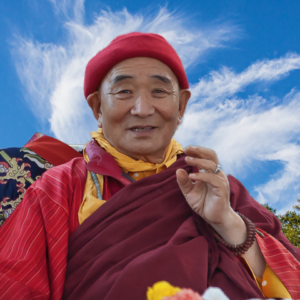
TARTHANG TULKU is one of the last surviving Tibetan lamas to have received a comprehensive traditional education in Old Tibet.
He founded several nonprofit organizations including Dharma Publishing and the Nyingma Institute.
On the web
nyingmainstitute.com
BOOKSHELF
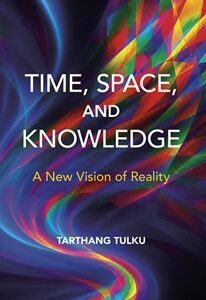
TIME, SPACE, AND KNOWLEDGE: A NEW VISION OF REALITY
BY TARTHANG TULKU,
published by Dharma Publishing
Paperback (344 pages)
